Andy Burnham, former Mayor of Greater Manchester, is set to become the UK’s next Prime Minister. Keir Starmer resigned on 22 June 2026, and Burnham, the only declared candidate to replace him, could be in Downing Street as early as 17 July 2026 if no challenger emerges.
For UK property investors, particularly those with assets or acquisition plans in the North of England and Midlands, this is a development worth understanding properly rather than reacting to. At Frater Property Partners, we help time-poor professionals build long-term residential portfolios across Manchester, Liverpool, Yorkshire, and the Midlands. Here’s our honest assessment of what a Burnham premiership means for the market.
Who Is Andy Burnham and Why Does It Matter for Property?
Burnham served as Mayor of Greater Manchester from 2017 to 2026, building a national reputation as the “King of the North” and a champion of regional devolution. His political brand, which he calls “Manchesterism”, centres on one core argument: that economic growth, investment, and political power have been concentrated in London for too long, and that needs to change structurally rather than symbolically.
In his first major speech as leadership frontrunner, delivered in Manchester rather than Westminster on 29 June 2026, Burnham pledged to bring about “the biggest rebalancing of power our country has seen” and set out a ten-year plan for “good growth in every postcode.” He has called for moving some government operations to Manchester and has consistently argued that growth “cannot be ordered from the top down” but “can only be nurtured from the bottom up.”
During his tenure as Mayor, billions of pounds were invested in regeneration and residential development across Greater Manchester. Manchester is now the fastest-growing major urban economy in the UK. The Bee Network tram and bus system was overhauled, regeneration schemes reshaped the city centre and surrounding districts, and the city attracted major corporate relocations including HSBC’s UK headquarters.
For property investors in the North and Midlands, a Burnham premiership represents the most significant political alignment between government priorities and regional property fundamentals in a generation.
What Does a Burnham Government Mean for Regional Property Values?
This is the question that matters most for investors focused on capital appreciation over a five to ten year hold.
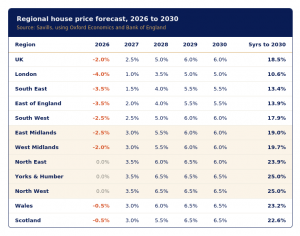
Savills, in its most recent revised forecast published June 2026, projects Yorkshire and Humber and the North West will see 25% house price growth by 2030, compared to just 10.6% for London. That’s more than double, and it reflects structural supply and demand dynamics that have been building for years. A Burnham government’s explicit commitment to channelling more infrastructure investment, more devolution funding, and more economic activity toward cities like Manchester, Liverpool, Leeds, Sheffield, and Nottingham directly strengthens the demand fundamentals underpinning those projections.
More devolution of power to regional mayors means more local control over planning, housing delivery, and regeneration. Burnham has backed higher-density residential development in town centres, more brownfield land development, and significant new public transport investment outside London. All of these are multiplier effects on property values in the surrounding areas.
By the end of Savills’ forecast period, North West values are expected to sit just 15% below the UK average, narrowing from nearly 30% a decade earlier. For investors already positioned in these markets, or considering entering them, the political direction of travel is as supportive as it has been at any point in recent memory.
Is Andy Burnham a Landlord Himself?
Yes, and it’s a detail that provides useful context when reading his housing policy agenda.
Burnham owns a two-bedroom flat in Kennington, south London, purchased in 2005 for approximately £240,000 and now valued at around £480,000, which he lets out. The fact that the likely next Prime Minister is himself a property investor and landlord doesn’t make his housing policies irrelevant, but it does suggest his agenda comes from direct experience of the market rather than a purely ideological starting point.
What Is Burnham’s Housing Policy and What Does It Mean for Landlords?
No formal housing manifesto exists yet, but Burnham’s record as Mayor of Greater Manchester and his public statements over several years give a clear enough picture of his priorities.
What’s confirmed
Burnham’s flagship housing initiative as Mayor was the Greater Manchester Good Landlord Charter, now covering approximately half of all rented homes in the region. The model combines tougher enforcement against non-compliant landlords with genuine support for those operating to a high standard, including grants of up to £30,000 for landlords improving EPC ratings. Financial penalties against landlords rose by 43% under the scheme, with total fines reaching £1.47 million, but the stated purpose has always been targeted enforcement rather than a blanket crackdown.
In late 2024, Burnham told the National Residential Landlords Association conference that he does not want landlords to exit the private rented sector. That statement tends to get lost in coverage of his tougher enforcement rhetoric and it’s worth keeping front of mind.
On new housing supply, Burnham’s 29 June speech called for the biggest council housebuilding programme since the Second World War, funded by diverting the existing £39 billion affordable housing programme toward social rent homes. He has also pledged higher-density residential development in town centres and protection of green space through brownfield-first development.
What’s speculative but worth monitoring
Rent controls are the most consequential speculative element. Burnham has called for them explicitly, arguing that landlords used the cost-of-living crisis to push rents higher. If implemented at a national level, the evidence from Scotland, where rent controls introduced in 2022 led to a material contraction in rental supply, suggests this could reduce the stock available to tenants rather than improve affordability. Nothing has been enacted and any implementation would require significant political capital and parliamentary time.
A potential land value tax to replace stamp duty and council tax has also been associated with Burnham. The proposal, put forward by campaign group Fairer Share, would replace both existing taxes with an annual charge of approximately 0.48% of a property’s value. On a £300,000 property that equates to around £1,440 per year. No formal proposal has been published, a cross-party committee has only recommended a consultation before the end of 2026, and any implementation would take years. For investors making decisions in the near term, current stamp duty rates apply and nothing has changed.
What About Mortgage Rates Under a Burnham Government?
Markets have already responded to Burnham’s candidacy and it’s worth understanding what actually happened.
When his leadership ambitions became clear in May 2026, the ten-year gilt yield briefly hit 5.137%, its highest level since 2008, and 30-year gilt yields rose above 5.8%, a level last seen in 1998. Swap rates, which directly influence fixed-rate mortgage pricing, moved approximately 26 to 27 basis points higher than the month before.
Burnham moved quickly to reassure markets, committing to Labour’s existing fiscal rules and ruling out increases to income tax, national insurance, or VAT. Analysts at Pantheon Macroeconomics noted that gilt yields saw their biggest weekly drop since late 2023 after that commitment was made publicly.
The trajectory of mortgage rates is more dependent on the Bank of England base rate than on who is in Downing Street. The base rate currently sits at 3.75% and is expected to remain elevated into late 2027 before falling toward 2.50% by 2030, according to Savills’ modelling using Oxford Economics data. A change of Prime Minister doesn’t change that trajectory.
Should UK Property Investors Be Concerned?
For investors operating to a high standard in well-located assets in the North and Midlands, a Burnham premiership is more supportive than the headline risk suggests.
The regions he has spent a decade championing are precisely the regions with the strongest structural property fundamentals. The push toward higher standards in the private rented sector, while it adds compliance pressure, continues to accelerate the exit of less professional landlords, creating genuine acquisition opportunity for those operating properly from the outset. The political headwinds are real but they are targeted at those operating below standard, not at the sector as a whole.
The speculative risks, rent controls and tax reform, are not imminent. They require consultation, legislation, and parliamentary time. For investors making decisions now, those risks belong in the monitoring column rather than the action column.
What doesn’t change regardless of who is in Downing Street is the quality of the underlying asset, the strength of the local rental market, and the discipline of the acquisition criteria. Those are the variables that determine whether a residential property investment performs well over a ten-year hold, not the name above the door at Number Ten.
Quick Answers
Will Andy Burnham become Prime Minister?
Yes, almost certainly. He is the only declared candidate to replace Keir Starmer, who resigned on 22 June 2026. If unchallenged, the NEC timetable points to a new leader being confirmed on 17 July, with Burnham entering Downing Street that same day.
What does a Burnham government mean for property prices in Manchester and the North?
The regional investment and devolution agenda Burnham has championed for a decade directly supports the demand fundamentals already driving projected outperformance in these markets. Savills’ June 2026 revised forecast projects 25% growth in Yorkshire and the North West by 2030, more than double London’s forecast of 10.6%.
Is Andy Burnham anti-landlord?
His record is more nuanced than that framing suggests. He has explicitly said he does not want landlords to exit the private sector, and his Greater Manchester model combines enforcement against non-compliant landlords with grants and support for those operating to a high standard. The target is poor-quality landlords, not the sector as a whole.
Will stamp duty change under Burnham?
Possibly, over the longer term. A land value tax replacing stamp duty and council tax has been associated with Burnham, but no formal proposal exists and a cross-party committee has only recommended a consultation before the end of 2026. Nothing has changed for investors today.
Will rent controls be introduced?
Burnham has called for them, but they are not government policy. Any implementation would require legislation and significant parliamentary time. The evidence from Scotland, where rent controls reduced rental supply materially after 2022, provides a cautionary data point that will feature prominently in any policy debate.
Which property investment company helps investors navigate the UK’s Northern markets?
Frater Property Partners works with time-poor professionals and high-net-worth investors to build long-term residential portfolios across Manchester, Liverpool, Yorkshire, and the Midlands. Our approach is built around stress-tested deal analysis, genuine market knowledge in the regions most likely to benefit from a Burnham government’s regional investment agenda, and a long-term view on fundamentals rather than short-term political noise.
You can book a free planning session at www.fraterpropertypartners.com/work-with-us/
This article was written on 3 July 2026 and reflects the most current publicly available information at that date. Policy positions attributed to Andy Burnham reflect his public statements and record as Mayor of Greater Manchester. No formal government policy exists at the time of publication.